
Finding Brighton Residents
No single household roll exists for Brighton. So the trail you follow depends on the question. Monroe County property records name the owner of record for a parcel, while the New York and Monroe voter tools confirm a known registration only when the required identifying details go into the form. Deeds connect recorded parties to a legal description. A directory or newspaper can still place a historical household at a printed address. These roles do not swap. An owner may mail tax notices elsewhere. A court party may never have lived in town. And a directory entry covers one year only.
Begin with the sturdiest fact in hand. For an address, hold onto the parcel number and legal description before you switch sources. For a person, keep the full name paired with an address, a year, or some other independent detail. That habit separates similar names and makes a later request to a clerk or library far more precise.
- Search the Monroe County Real Property portal by owner, address, or parcel number and save the situs and mailing fields separately.
- Use the Monroe County Parcel Viewer to confirm the parcel, boundaries, ZIP layer, and nearby addresses.
- Verify a known voter through the state or county form only when the requested date of birth and address are available.
- Search the Clerk index for recorded land parties, then compare its legal description with the parcel record.
- For earlier households, move to the library directories, newspapers, maps, and census material rather than forcing a modern record to answer a historical question.
Brighton Resident Records Offices
Different custodians hold different Brighton records. The Town Assessor runs the local assessment function. Monroe County supplies the property portal, the mapping service, and the land-records office, and the county Board of Elections handles local voter information. Each office publishes its own kind of evidence, and the non-digital routes matter when an index stops short or a copy must be certified. Address-level work belongs in the Brighton street directory path. This overview stays on choosing the right custodian.
Monroe County Clerk
39 West Main Street, Rooms 101 and 105
Rochester, NY 14614
585-753-1600
Brighton Assessor
Town of Brighton assessment office
Rochester, NY
585-784-5215
The town's offices have used a temporary 680 Westfall Road location during the Town Hall renovation. Mail still goes to 2300 Elmwood Avenue. Check the current town contact page before any in-person request.
Brighton Parcel Roll Starts
For a Brighton address, the assessment roll is the strongest current starting point. Public fields can include the tax-map parcel number, the current owner name, the owner mailing address, the property location, class, school district, assessment values, exemptions, special districts, the account number, and the deed book and page. The county portal and the 2025 Brighton final roll should be read as property records. They are not a complete list of everyone at the house.
| Parcel search field | How it helps | Careful reading |
|---|---|---|
| Owner name | Finds the owner of record | It does not confirm occupancy. |
| Street address | Locates the situs property | Normalize direction and street suffixes. |
| Parcel or SBL | Bridges to GIS and deed records | Copy Brighton’s dotted number exactly. |
| Tax year | Places the record in a roll period | Save whether it is tentative or final. |
- Parcel
- A mapped tax property with its own identifier, even when a street address changes.
- Situs address
- The physical property location used by assessment and mapping records.
- Mailing address
- The address used for tax correspondence, which may not be where the owner lives.
- Index
- A finding list that points to a record. It is not always the document image itself.
Brighton Addresses Have Three Keys
A Brighton property can carry a Rochester postal address. It may still sit in the Town of Brighton. Keep three identifiers apart. The situs address is one key. The tax mailing address is another. The third is the legal description or SBL. It is especially useful when an old street number or road name has changed. Monroe GIS links the parcel shape to property information. It can display ZIP, municipal, school, fire, and other district layers.
The distinction matters most around Browncroft. Part of that area moved from Brighton to Rochester in 1905. The annexation law changed in 1913. The broader annexation took effect on January 1, 1914. A historical address there may require records from both jurisdictions. Treat the map as a geography check rather than a resident list.
Note: A Rochester postal city on a tax record does not establish City of Rochester jurisdiction by itself.
Brighton Directory Sources Today
Today's directory-like sources each describe one public role. They work best as an evidence ladder. Mapping locates the parcel. Assessment identifies an owner of record. A deed names recorded parties, and voter confirmation checks a known registration. The Brighton resident lookup route stacks those layers to verify one person without treating any single result as conclusive.
| Brighton source | What it can show | Keeper | Access path |
|---|---|---|---|
| Assessment roll | Owner of record, situs, mailing address, parcel fields | Brighton and Monroe County | Public roll and county portal |
| Parcel Viewer | Parcel geometry, address, SBL, ZIP and boundary context | Monroe GIS | Public interactive map |
| Voter confirmation | Known registered-voter and election information | NYS and Monroe BOE | Individual match form |
| Land index | Grantors, grantees, document details, recording trail | Monroe County Clerk | Guest index, terminal, or copy request |
| Library directories | Historical occupants and address clues | RPL and Brighton Memorial Library | Scans, shelves, and reference help |
Neighborhood associations supply community history and contact routes, not public membership rosters. Roselawn, Meadowbrook, Bel-Air, and other local groups give useful context when an address sits in a known neighborhood. Still, never assume a member list exists.
Brighton Voter Verification Limits
The NYS Voter Registration Lookup asks for five things. You supply last name, first name, date of birth, county, and address. Monroe's tool works differently. It wants a street number, a selected street name, ZIP code, last name, and date of birth. Both are confirmation tools for a known person. Neither lets you browse every household on a street. New York Election Law § 3-103(5) adds one more limit. It places an election-purpose certification condition on full voter-file requests.
| State lookup field | Form use | Brighton instruction |
|---|---|---|
| Last and first name | Required identity fields | Use the registered spelling. |
| Date of birth | Required verification field | Enter the requested MM/DD/YYYY form. |
| County | Required jurisdiction | Select Monroe for Brighton. |
| Address | Required match field | Use the current registration format. |
The state voter lookup appears here because its form shows why a partial name alone cannot deliver a reliable Brighton resident match.
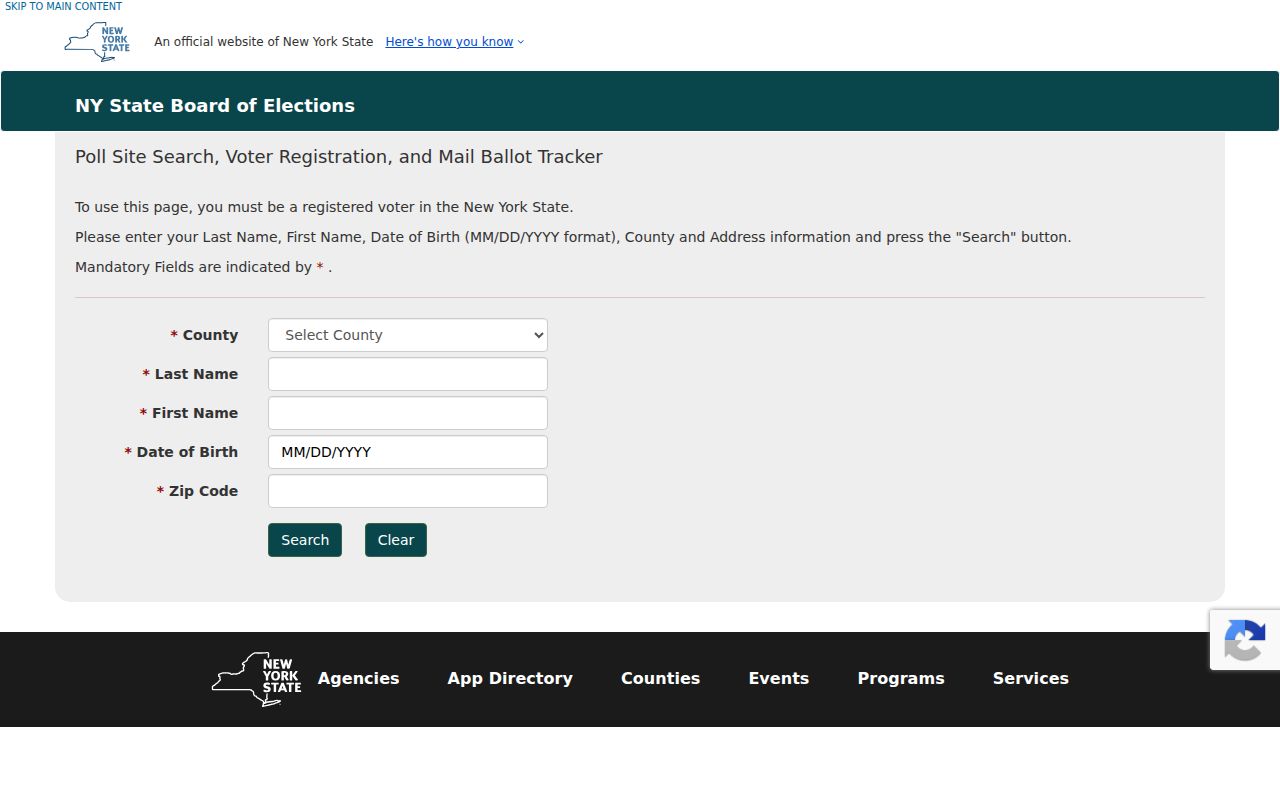
Those required fields block a broad name-only search and keep each result focused on registration information.
Brighton Deed Trail Access
The SearchIQS Monroe index ties recorded grants, purchases, mortgages, liens, and maps into the county land-records trail. Party-name and property-address indexing stays open to a guest under the 2026 change. Original images need a subscription or the Clerk's free public terminal. The County Clerk also takes mail, phone, fax, and online document requests. That wider chain matters. A result must sometimes be a certified copy. An online image can be unavailable.
| Access route | What it supplies | When to use it |
|---|---|---|
| Guest index | Party and property search | First pass for an indexed document. |
| Public terminal | Image access at the Clerk | When an online image is gated. |
| Room 105 books and microfilm | Earlier grantor-grantee work | For pre-1975 research. |
| Document-order form | Land, court, or other copies | For a defined record and delivery method. |
Deeds move through paperwork. The Clerk's document-order form splits requests into Land, Court, and Other categories, then asks for a property address, tax ID, case caption, document type, delivery method, and a certification choice.
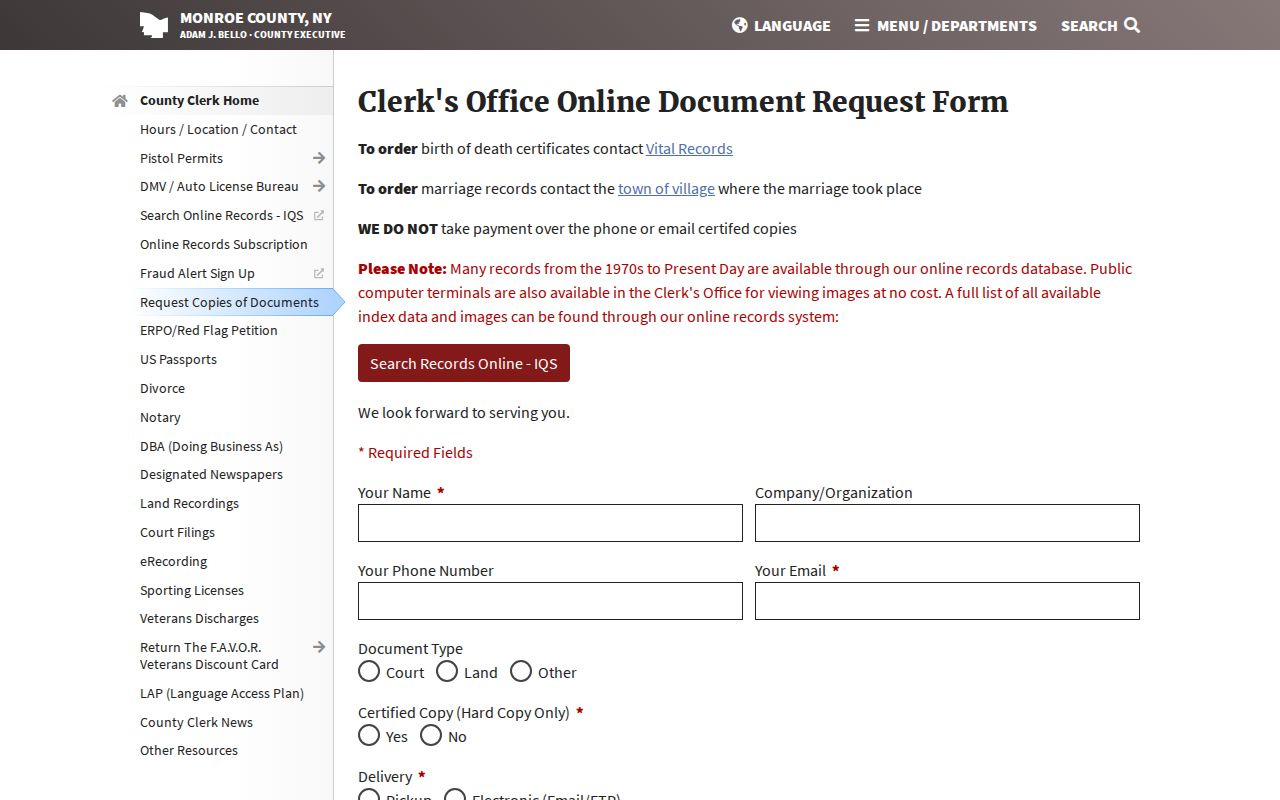
Specifics beat generality at the Clerk's counter. A parcel number, the parties' names, and a date range give staff a real starting point, while a broad request for someone's records leaves too much ground to search.
Brighton Court Party Searches
New York's statewide civil tool covers the party side of a lookup. WebCivil Local allows searches by party, attorney, judge, index number, court, case type, filing year, and status. A result can list the case number, party names and roles, court, case type, filing information, status, and appearance details. Brighton Town Court is different. The town offers no public name-search portal. A local file request goes to the clerk with a party name, approximate date, ticket or index number, and the copy or certification wanted. Keep the limits in view. Protected cases stay out of online coverage. Entries can lag behind filings. A party name alone proves neither a Brighton address nor any wrongdoing, so ask the court whether a file is active, archived, sealed, redacted, or eligible for a certified copy. Note: A court index leads to an official file but never replaces the court's record or confirms residence.
Brighton Historical Directory Shelves
Old households make this a library project. Rochester Public Library's collection starts with directories from 1827, includes fifteen House Directory volumes for 1892 through 1920, and adds house sections to regular volumes beginning in 1922 or 1924. The 1930 through 1940 suburban run names Brighton explicitly. Coverage is not universal. Some Rochester volumes skip the town entirely. Pick a suburban volume when one exists, and read its stated scope before trusting a negative result. The digitized Rochester directories collection blends scanned images with bound originals, while Brighton Memorial Library adds town documents, microfilm, photographs, and Brighton-Pittsford Post holdings. RPL's Rundel division supplies deeper local-history research support. A directory places an occupant at an address. Only a deed names recorded ownership, so the two sources answer different questions about the same Brighton household.
Brighton Newspaper Record Trail
Newspapers supply what a property roll cannot. Brighton Memorial Library's 2026 local-research program featured digitized Jewish Tidings from 1887 through 1894, Jewish Ledger from 1924 through 1993, and Brighton-Pittsford Post material from 1943 through 2015. RPL describes its Post holdings more broadly, so a reference-desk check is the way to confirm a particular issue. Two indexes speed the work. The library's city-directory name index covers 21,199 names for 1876 through 1889. The 1872 Beers Atlas index tops 11,500 owners. Guesswork is not evidence. Match a newspaper notice or directory lead to a deed, probate file, or vital record before concluding anything about a Brighton household.
Brighton ZIP Records Need Boundaries
Postal codes in Brighton run 14610, 14618, 14620, 14623, and 14625 across official town and assessment material. The 2025 town survey put 14618 far ahead, covering 73.8 percent of reported ZIP distribution, with each remaining code taking a smaller share. Remember that these are delivery areas, not municipal lines. 14623 reaches into Henrietta. 14625 crosses several nearby jurisdictions. A ZIP can narrow a lookup in the residents directory, but the municipality, parcel record, or GIS layer settles whether an address truly sits inside Brighton.
To confirm an exact mailing address, the USPS ZIP Lookup is the authoritative check. Pair it with the parcel map for municipal geography, and keep the postal city distinct from the actual town jurisdiction when reading any directory entry.
Brighton Genealogy Record Windows
Vital records can strengthen a historical Brighton residents directory search. They just work differently from ordinary name-search records. The State Archives holds vital index microfiche for events outside New York City. Births there run from 1881 through 1935, marriages from 1881 through 1960, and deaths from 1880 through 1960. Treat that index as a finding aid rather than an online certificate database. For a more recent event, start with the proper local registrar or the New York State Department of Health. Then follow the stated eligibility route.
Timing rules matter here. The NYS genealogy application process generally opens an uncertified birth search after 75 years when the person is known deceased. A death search opens after 50 years. A marriage search opens after 50 years once both parties are deceased. A direct descendant with proof can seek an exception. For a marriage license issued in Brighton, copies begin with the Town Clerk. Certified copies then follow separate relationship and identification rules.
When an older family record could corroborate a directory or obituary lead, the state genealogy page lays out the search periods, the application, and the mail process from start to finish.
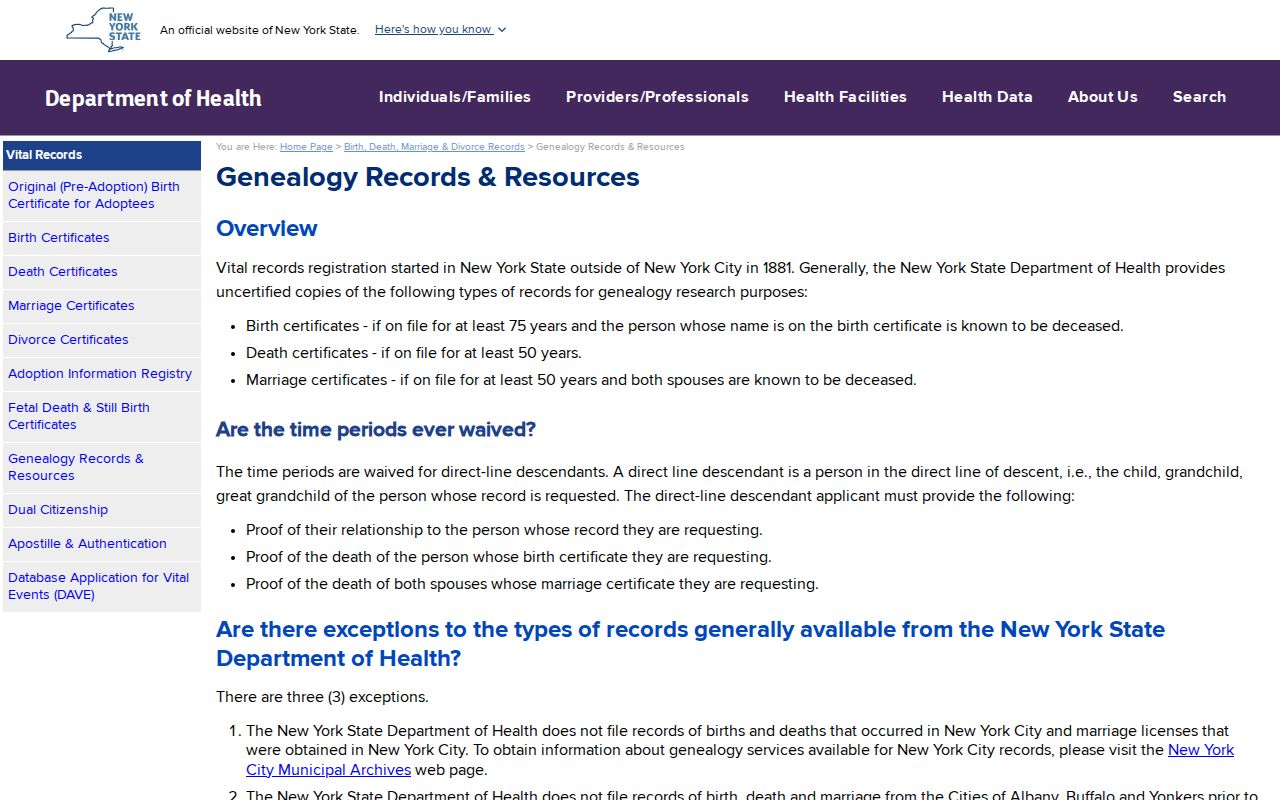
Preparation pays off here. The application wants event details, name variants, relationship information, and a search range. Directory facts gathered first keep that search tight. Note: A genealogy result can confirm an event but does not turn a restricted current certificate into a public resident record.
Brighton Privacy Lines
Some records simply stay closed. Assessment rolls name owners, not every person in the home. DMV address files, utility accounts, delivery records, sealed court material, confidential voter records, and restricted vital records never function as a public residents directory. Monroe County keeps confidential-voter files outside public inspection through the state process. New York's Address Confidentiality Program gives eligible participants a substitute address as well. Certain households stay off any resident lookup by design.
When a record is not online, go to the custodian. New York's Freedom of Information Law, Public Officers Law Article 6, is the fallback for non-exempt town and county records. A good request names the record, the date range, and the address or parcel. Say whether you want to inspect it or receive copies. The agency then has five business days to grant, deny, or acknowledge the request. If more time is needed, it must give an estimated fulfillment date.